
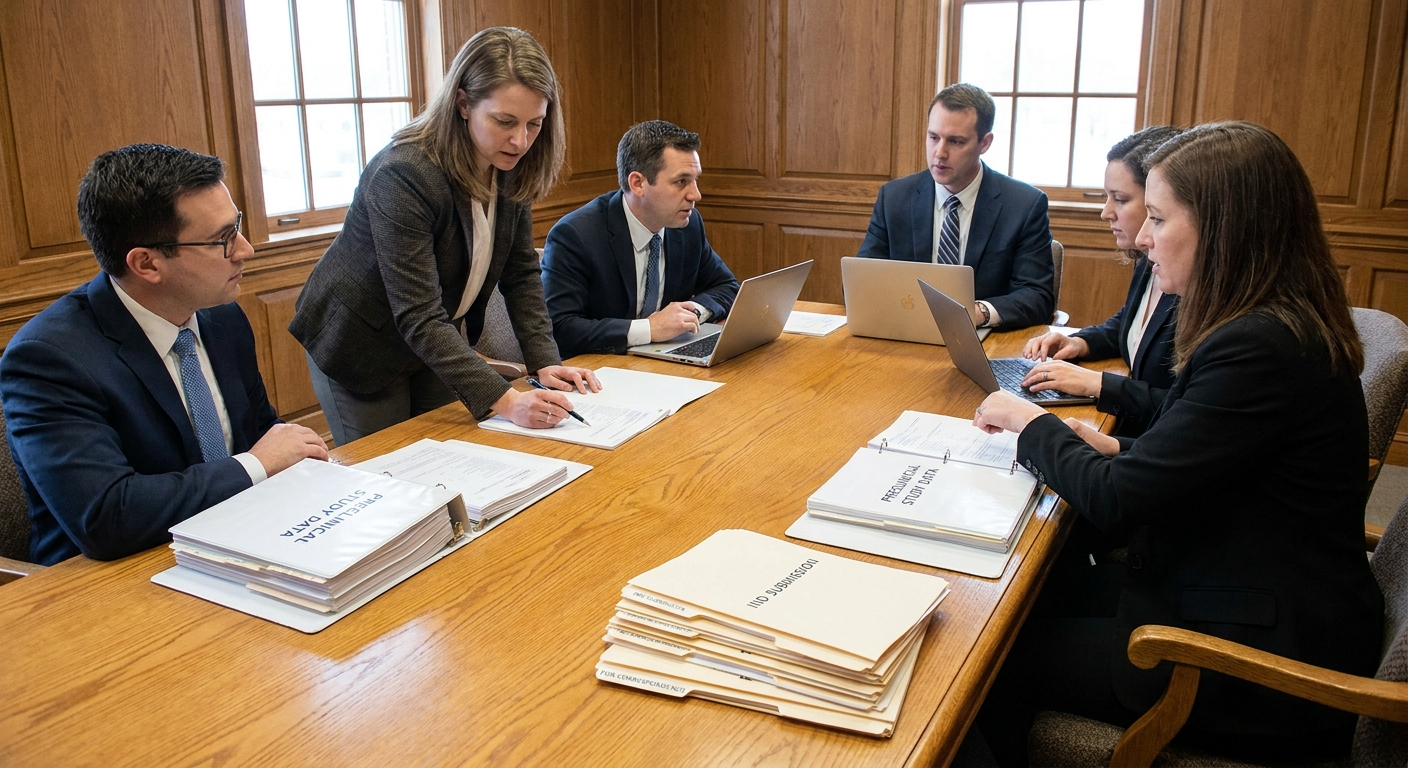
The preclinical package must answer the questions regulators will ask when they review your IND: What dose is safe? How is the compound metabolized? Will the pharmacokinetics in rodents and dogs translate to humans? BioMate integrates the computational methods that address these questions — reducing the experimental burden and improving the quality of the regulatory documentation that comes out the other side.
Translational PK: From Animal to Human
Physiologically-based pharmacokinetic (PBPK) modeling simulates how a compound moves through, and is processed by, the body — as a function of the organism's physiology rather than empirical curve-fitting. A PBPK model parameterized with in vitro measurements and animal PK data can predict human PK ahead of clinical trials, estimate the effect of hepatic impairment or drug interactions on exposure, and simulate special populations whose inclusion in early trials is limited.
Allometric scaling provides a complementary, faster estimate of human dose based on body weight relationships across species. BioMate implements both, allowing teams to triangulate the predicted human dose and exposure from multiple methods — the regulatory expectation for a well-supported IND application.
Toxicology Prediction
Preclinical toxicology generates the safety data that defines the starting dose and dose escalation scheme for the first human study. BioMate integrates computational toxicology models for repeated-dose hepatotoxicity, developmental and reproductive toxicity (DART), and genotoxicity — not to replace GLP toxicology studies, but to identify likely liabilities early enough to address them structurally, and to inform the design of the definitive studies by predicting the dose range where signals are likely to emerge.
"IND preparation is documentation-intensive by design. Regulators need to see that every prediction is supported by a method, every method by a reference, and every result by a QC record. BioMate generates all three."
CRO Submission and IND Assembly
When preclinical studies are outsourced to contract research organizations, the data handoff is often a friction point — formatting compound data, writing assay specifications, attaching computational predictions in a form the CRO can act on. BioMate generates structured submission packages that consolidate compound records, assay requirements, predicted dose ranges, and relevant computational context in formats that major CROs consume directly.
For IND assembly, BioMate organizes the computational pharmacology and toxicology evidence into the section structure regulators expect. The audit trail attached to each analysis provides the method citations, parameter provenance, and QC records that reviewers require to assess the reliability of the predictions.
Further reading: FDA Investigational New Drug (IND) application guidance, ICH safety guidelines, EMA non-clinical pharmacokinetics guidelines, and PBPK modelling review (NIH/PMC).
Computational PK/PD modeling and toxicology prediction are no longer tasks that require a dedicated pharmacometrician or regulatory toxicologist. BioMate makes them accessible at the bench-scientist level — with the documentation quality the IND requires built in from the start.