
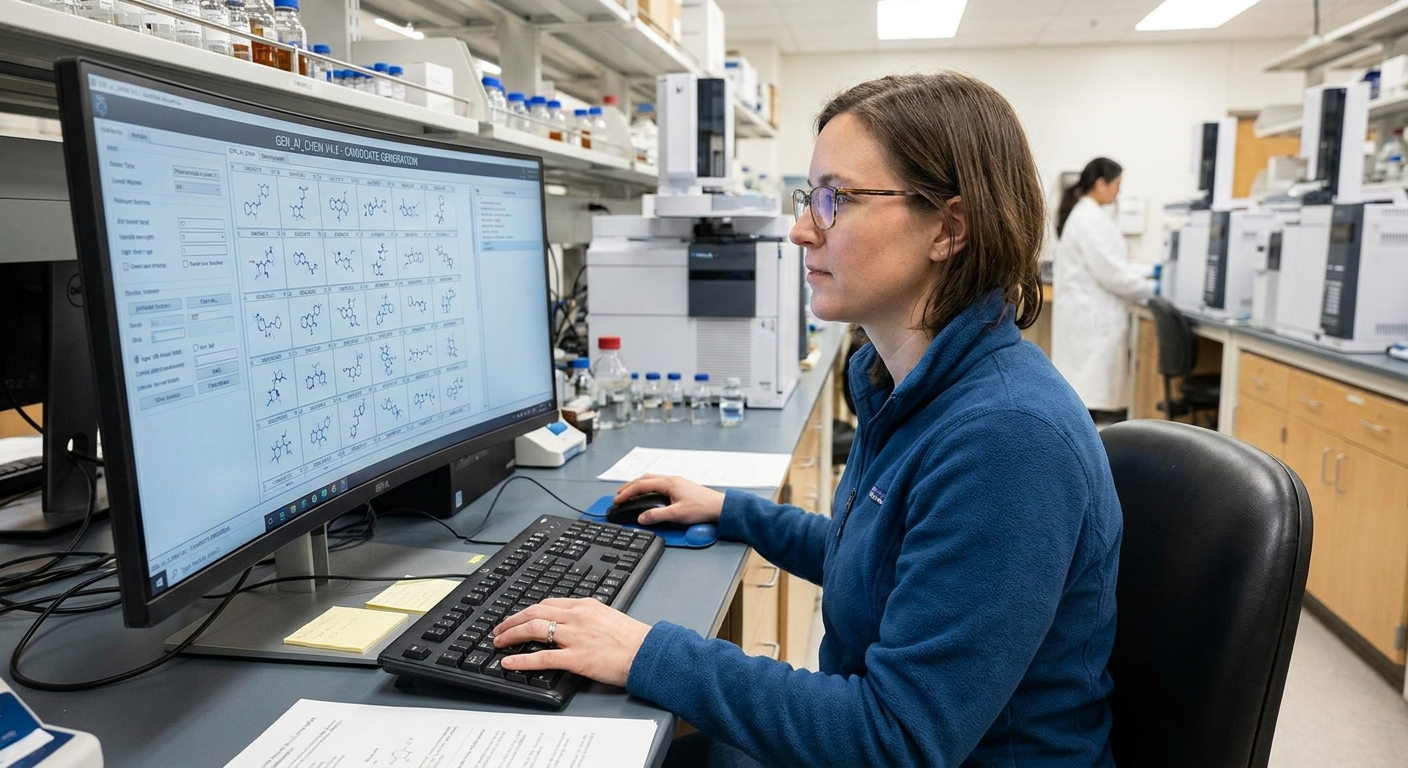
Once a lead scaffold is identified, the medicinal chemistry question shifts from "does it bind?" to "how do we make it better?" Traditional medicinal chemistry iterates through analog synthesis, testing structural modifications one at a time. Generative molecular design explores the chemical space around a scaffold computationally — generating hundreds of variants optimized against a defined property profile simultaneously.
The Optimization Problem
Lead optimization is a multi-objective problem. The ideal compound binds the target potently, is selective against off-targets, is absorbed reliably after oral dosing, avoids the cardiac hERG channel, is not rapidly metabolized, and is synthesizable at reasonable cost. No single structural modification improves all of these simultaneously — the art of medicinal chemistry lies in navigating the tradeoffs intelligently.
Generative design approaches this problem by treating it explicitly as optimization: define the scoring function that captures the target property profile, train a generative model to produce chemical structures, and use a feedback loop to guide the model toward the region of chemical space where the scoring function is high. The result is a set of structurally diverse candidates that have all been evaluated against the full property profile — not just the one or two properties the medicinal chemist had time to synthesize toward manually.
How REINVENT4 Works in BioMate
REINVENT4 is a reinforcement learning-based generative chemistry system. A prior model, trained on large libraries of known drug-like compounds, learns the statistical structure of medicinal chemistry space. A scoring function — composed of docking scores, ADMET predictions, synthetic accessibility estimates, and selectivity constraints — provides the reward signal. The agent iterates, generating compounds, scoring them, and updating the generative model to produce more compounds in high-scoring regions of space.
BioMate wraps the full REINVENT4 workflow: prior selection or training, scoring function definition from the compound's current property profile, generation, post-filtering for PAINS alerts and Lipinski violations, and clustering for structural diversity. The output is a ranked, diverse set of candidates with full property predictions and synthesis accessibility estimates attached.
"Generative design does not replace medicinal chemistry intuition. It gives medicinal chemists a pre-filtered set of candidates to apply their intuition to — from a much larger starting space than manual design can reach."
Setting Up a Meaningful Scoring Function
The quality of generative design output depends entirely on the quality of the scoring function. A scoring function that overweights binding score at the expense of ADMET properties will generate potent but undevelopable compounds. BioMate guides the scoring function setup based on the compound's current liability profile — weighting the properties that are furthest from target most heavily, so the generative model focuses its exploration where the structural improvement is needed most.
Further reading: REINVENT4 (AstraZeneca Molecular AI, GitHub), ChEMBL bioactivity database (EBI), RDKit open-source cheminformatics, and Olivecrona et al., reinforcement learning for molecular design.
The analog space around your lead scaffold is explored computationally before it is explored synthetically. Only compounds that score well across the full property profile are presented for synthesis consideration — reducing the number of synthesis cycles needed to reach a development candidate.