

How we design · 中文
How we design
medicines
Designed in silico · tested in the lab · guided by patient data
Three loops not one
Computer lab and clinic
three loops that compound
Real drug design runs more than one loop — and its most valuable input is patient and clinical data. ① An in-silico loop generates and scores candidates against everything we know — patient and clinical data, known biology and structure, patents and freedom-to-operate, medicinal-chemist expertise, and our predictors — over many fast, low-cost rounds that converge on a small set, before anything is synthesized. ② A wet-lab loop takes over from there — synthesis, in-vitro assays, ADMET and in-vivo are all experimental — and the results recalibrate the computational models, so each in-silico round sharpens while each wet-lab round shrinks. ③ A clinical loop closes around both: patient and clinical data guides which targets to pursue and validates the mechanism, feeding back so the whole system gets better at choosing what to make.
Picking the right target is its own discipline — see how we identify targets →
Before anything is made
We check what matters
not just whether it works
Most candidate medicines fail late, for reasons that could have been caught early. We weigh all of them together, from the start.
The right target
Designed to act where it should — and leave the rest alone.
Able to become a medicine
Stable, deliverable and manufacturable — not just active in a dish.
New and ownable
Distinct from what already exists, with clear freedom to develop.
True to the biology
Grounded in how each target actually behaves in the body.
Balanced not one-sided
Activity, safety and makeability weighed together — the real trade-off.
Proven at the bench
The lab, not the model, has the final say.
The lab decides
The wet lab has
the final say
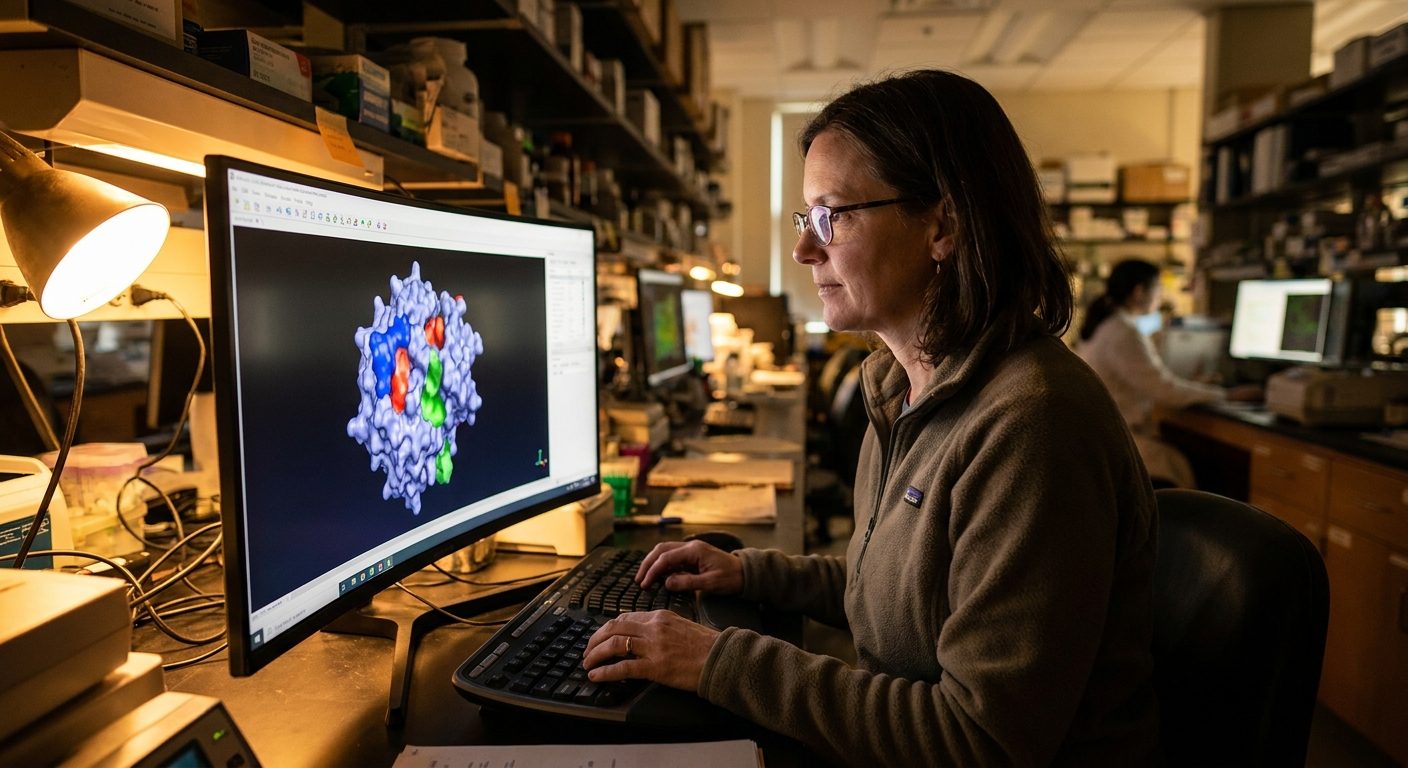
Every design is made and tested for real. Those results feed back into the next round — so the work compounds, and the ideas that advance are the ones that hold up at the bench.
See where we focus →